

Networks
DWDM and dark fibre for data centre interconnect: a practical guide for UK projects
· 9 min read
Dense wavelength division multiplexing (DWDM) carries multiple signals on a single fibre pair by assigning each signal a different optical wavelength. A single OS2 fibre pair can carry 40 to 96 DWDM channels at 100Gbps each, giving effective aggregate throughput in the multi-terabit range over distances up to thousands of kilometres. In a data centre context, DWDM is used for high-capacity links between rooms within a campus and for dark fibre connections between sites. The choice between passive DWDM, active DWDM and leased wavelengths depends on distance, required capacity and the balance between capital expenditure and recurring cost.
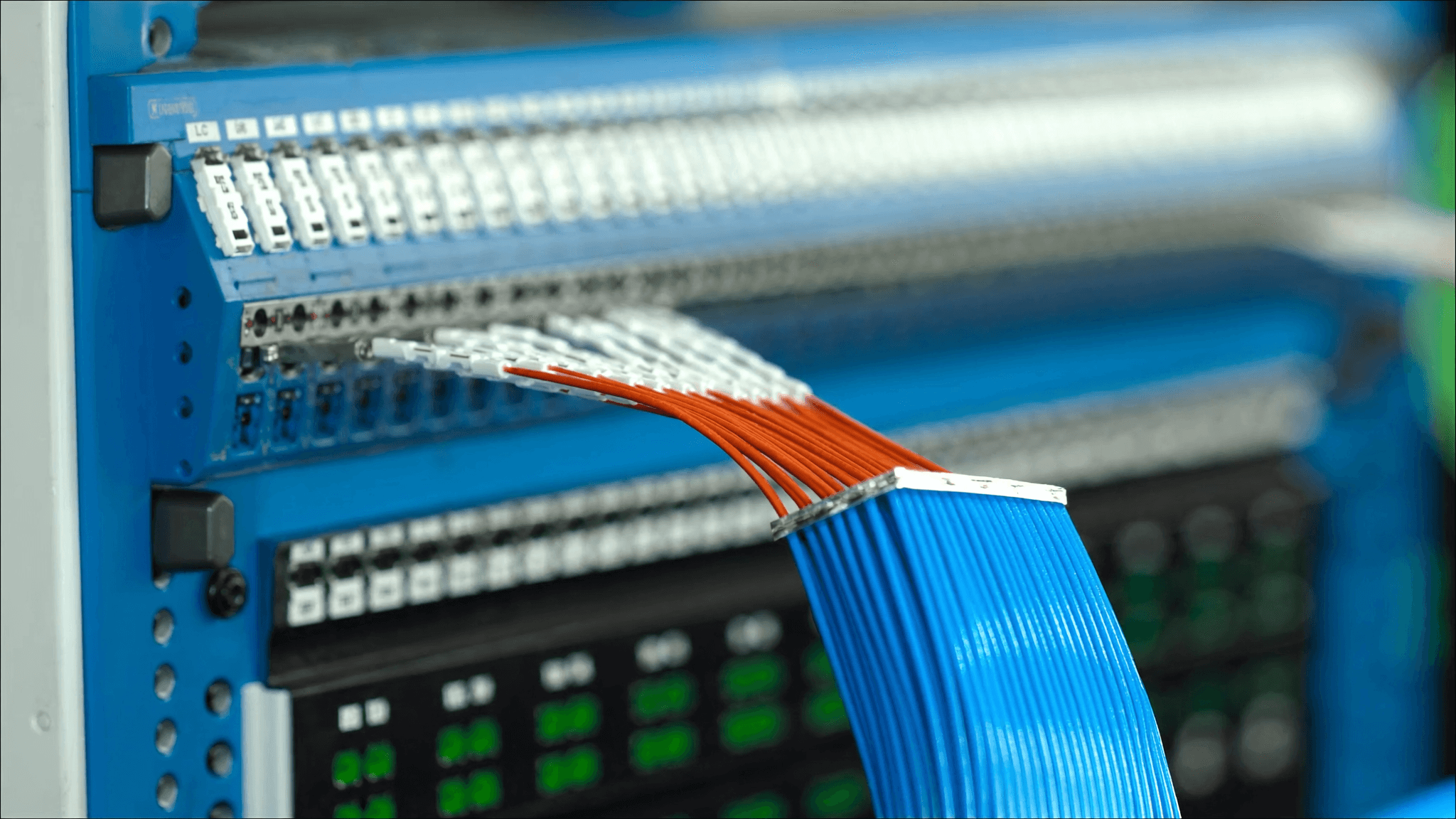
What DWDM is and what it does
Wavelength division multiplexing (WDM) is a technique that carries multiple optical signals simultaneously on a single fibre by using a different wavelength of light for each signal. DWDM uses narrowly spaced wavelengths on the ITU-T C-band grid, with channel spacings of 50GHz or 100GHz, allowing up to 80 or 96 channels per fibre pair depending on the grid used. Coarse wavelength division multiplexing (CWDM) uses wider channel spacings (20nm) and supports up to 18 channels per fibre pair. DWDM is the standard for inter-data-centre links where high capacity and long reach are required; CWDM is used for lower-capacity short-range links within a campus.
Dark fibre: what it means and when it is the right choice
Dark fibre is a fibre pair that has been physically installed between two points but carries no active signal: the wavelengths are the customer's to light with their own equipment. Leasing dark fibre gives complete control over the capacity and the technology used to light it, with no per-wavelength or per-gigabit cost beyond the dark fibre lease itself. The trade-off is that the customer is responsible for providing and maintaining the DWDM equipment at both ends. Dark fibre leases typically run for three to seven years and require a minimum commitment.
Dark fibre is the right choice when the required capacity justifies the capital expenditure on DWDM equipment, when the operator needs full control over the wavelength plan and the ability to add channels without involving the carrier, and when the link is expected to carry traffic for long enough that the capital cost is lower than the equivalent in leased wavelengths. For lower-capacity requirements or shorter commitment periods, a leased wavelength or an Ethernet-over-MPLS circuit from a connectivity provider is often more cost-effective.
Passive versus active DWDM
The loss budget: why it determines the design
The loss budget for a DWDM link is the maximum optical loss the transceiver pair can tolerate while maintaining the required bit error rate. Loss is introduced by the fibre itself (approximately 0.2dB per kilometre for OS2), by each connector pair (approximately 0.5dB for a well-made LC connector, up to 0.3dB for a well-made MPO connector), and by each DWDM mux/demux element (typically 3 to 5dB insertion loss per element at the relevant wavelength). The link budget calculation must account for all loss elements in the path before selecting transceivers, and should include a design margin of 3 to 4dB for connector ageing and future splices.
Transceiver selection: coherent versus intensity-modulated
Short-reach DWDM links (typically up to 80km) commonly use direct-detect or intensity-modulated direct-detect (IMDD) transceivers, which are lower cost and less complex. Longer-reach links (from approximately 80km to thousands of kilometres) use coherent transceivers, which encode multiple bits per symbol using the amplitude, phase and polarisation of the optical carrier, achieving higher spectral efficiency and better tolerance of chromatic dispersion and noise. Coherent transceivers are now available in QSFP28 form factor at 100Gbps, making them accessible for enterprise deployments where previously only service providers could justify the cost.
| Feature | Leased wavelength | Dark fibre with DWDM equipment |
|---|---|---|
| Capital expenditure | Low (no DWDM equipment to purchase) | High (DWDM equipment, transceivers, management) |
| Recurring cost | High (per-wavelength or per-Gbps pricing) | Low (dark fibre lease only) |
| Capacity flexibility | Fixed at contract; upgrade requires a new order | Add channels independently when needed |
| Technology control | Carrier determines the modulation and reach | Customer selects transceivers and DWDM gear |
| Break-even point | Lower cost below the break-even traffic threshold | Lower cost above the break-even threshold (typically 10–40Gbps sustained) |
What a UK data centre interconnect project involves
A DWDM fibre design project in the UK typically begins with a route survey: identifying the available dark fibre providers between the two end-points, the fibre specifications available (number of pairs, fibre grade, loss measurements), and the lead time for provisioning. Where no dark fibre exists on the required route, this stage may involve a civil works element to install new duct and cable, which adds cost and lead time. Once the fibre is provisioned, the design phase specifies the DWDM equipment at each end, the wavelength plan, the amplification requirements and the network management approach.
Design decisions that strand capacity
- Specifying CWDM where the route will later need DWDM: CWDM channels cannot be converted to DWDM channels without replacing all the mux/demux hardware
- Installing passive DWDM hardware that covers only 40 channels when the wavelength plan eventually requires 80: half the capacity of the fibre is inaccessible without replacing the mux/demux
- Selecting transceivers with insufficient reach for the actual loss budget: the link will fail under real conditions even if bench testing passed
- Not including a design margin in the loss budget: connector ageing and future splices will consume the remaining margin and the link will degrade before the end of the infrastructure life
- Specifying a dispersion-uncompensated design for a legacy fibre type that requires dispersion compensation at 100Gbps: the link will not achieve the required bit error rate at the target speed