

Operations
What is data centre smart hands, and when do you need it?
· 7 min read
Smart hands is skilled technical work carried out on your behalf inside a data centre you cannot reach quickly. It covers installing and cabling hardware, swapping failed components, running console sessions, tracing faults and troubleshooting alongside your team on the phone. You need it when the work requires somebody physically present who can exercise judgement, and when the real cost of sending your own engineer, counting travel time, a hotel night and the hours they are not doing their actual job, is higher than dispatching a vetted engineer who is already nearby.

A switch stops responding at two in the morning. Monitoring says the port is down. Nobody yet knows whether a transceiver has failed, a cable has been knocked out of its socket, or the line card has gone. The building is 300 miles away, and the nearest person who could walk the aisle and look is asleep. Everything about the next four hours depends on somebody being in that row.
That gap, between knowing something is wrong and having hands on the equipment, is what smart hands exists to close.
What smart hands actually means
Smart hands is skilled on-site work performed on your behalf by an engineer who is already local to the facility. It covers racking and cabling new hardware, swapping failed components, reseating optics, running console sessions, tracing a cable to the port it actually lands on, and troubleshooting live with your own engineers on the phone.
The word that matters in that description is judgement. An engineer who can report that a transceiver light is amber rather than off, and that the fibre is seated the wrong way round, has told you something a pair of hands following instructions could not. That is the line between smart hands and the simpler remote hands most facilities include, and it is the reason the two are usually priced and scoped differently.
The situations that tell you that you need it
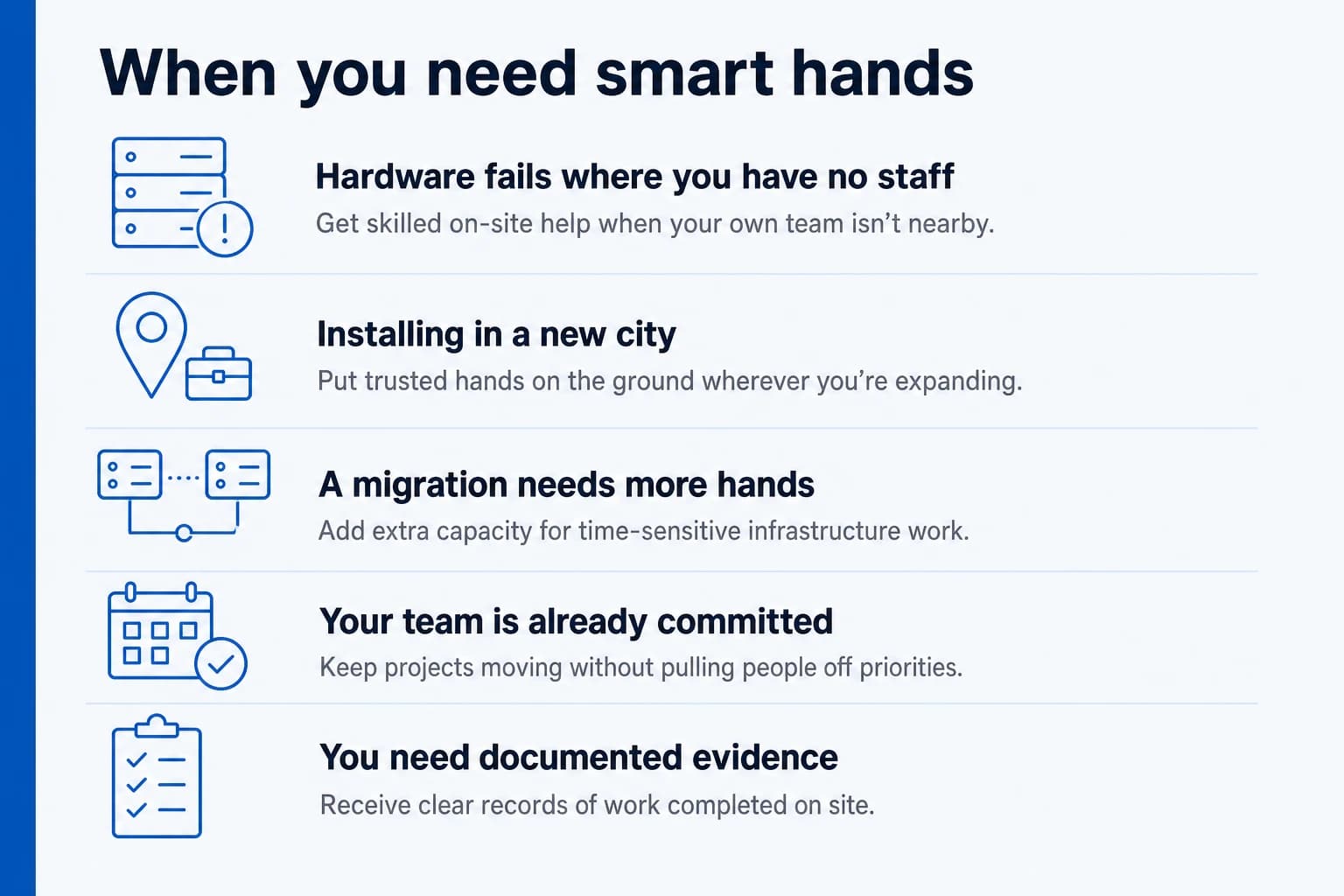
The question is rarely whether smart hands is useful in the abstract. It is whether this particular piece of work justifies it. These five situations are the ones that usually settle it.
| Feature | What it costs you otherwise | What smart hands changes |
|---|---|---|
| Hardware fails where you have no staff | A flight, a hotel night, and an engineer out of action for two days | Somebody qualified in the aisle within hours |
| You are installing in a city you have never worked in | Recruiting or flying people in before the site earns anything | Local capacity you pay for only when you use it |
| A migration needs more hands than you have | The move window slips, or your team works hours nobody should | Extra vetted hands for the window itself, then gone |
| Your own team is already committed | The incident queues behind planned work someone has to deprioritise | Parallel capacity, with nothing reshuffled |
| You need documented evidence of what was done | Somebody reconstructs it from memory weeks later | Photographs and a written handback at the time |
When you do not need it
It is worth being equally clear about the cases where dispatching an engineer is the wrong answer, because paying for attendance you did not need is how the service gets a reputation it does not deserve.
- The fault can be cleared over the network, and you have the access to do it
- Your own people are already on site for something else that day
- The work must be done by a vendor-certified engineer to keep a warranty intact
- It is a single, unambiguous cable swap and somebody in the building can do it
The thing that decides whether it works: access
The most common reason a dispatch stalls is not finding an engineer. It is an engineer sitting in reception without authorisation while the outage continues. Access is the part that is slow to arrange under pressure and quick to arrange in advance, which makes it the single highest-value thing to sort out before you need any of this.
- Agree in advance who can be added to the facility access list, and how quickly
- Keep current rack elevations and a labelling scheme somebody unfamiliar can follow
- Name an escalation contact who can answer a question at three in the morning
- Write down the scope boundary: what an engineer may do without asking, and what they must stop and check
- Decide what evidence you want back, and in what form
How to judge a provider before you need one
Most of these questions are awkward to ask during an incident and straightforward to ask now.
- Can you see the vetting evidence for the named engineer who will attend?
- Is there genuine coverage in the cities where your estate actually sits?
- Does the same operating standard apply in every one of them, or only the main ones?
- What documentation comes back afterwards, and does it include photographs?
- How is facility access handled, and who arranges it?
The answers tell you more than a price list will. A provider who is precise about what they will not do is usually the one being straight about what they will.